
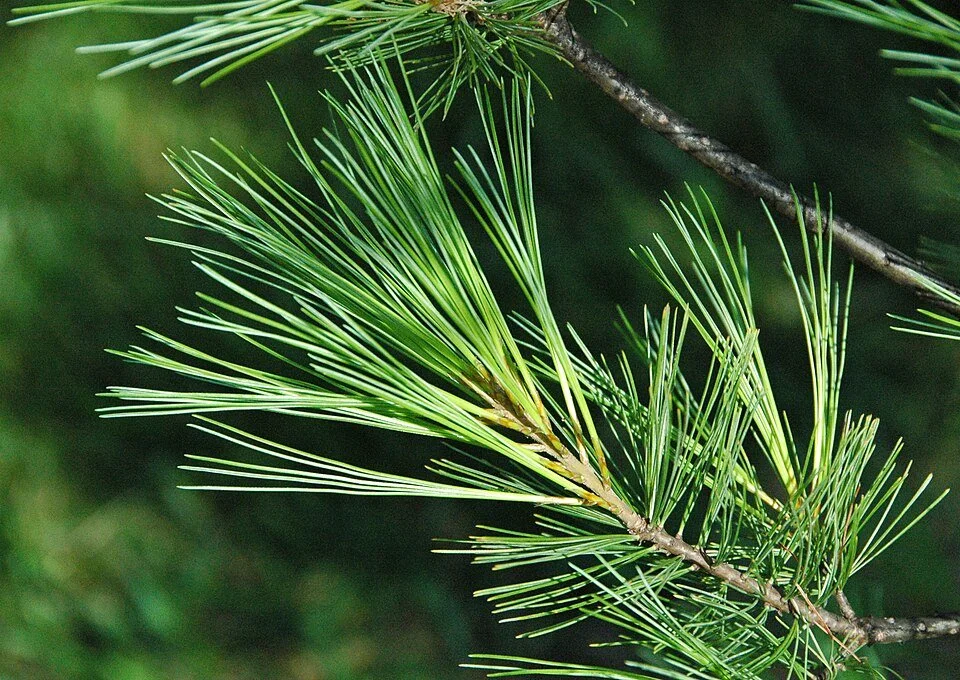
A Friend to All
The feathery, yet solid Eastern White Pine tree has been in relationship with the people and wildlife of this land for millennia. Found in every county of New York State, it provides nourishment and habitat for wildlife and holds symbolic significance for the original caretakers of this land.
The White Pine is ceremonially and traditionally meaningful to many Indigenous nations in the northeastern United States, but especially to the Haudenosaunee Confederacy. The oral history of the Great Law of Peace, Gayanesshagowa, which unites the five Nations of the Confederacy (Mohawk, Oneida, Onondaga, Cayuga, and Seneca), names this tree as the “Great Tree of Peace.” It stood as an essential landmark in the history of the unification of the five groups and sheltered the meeting of the Nations to establish Gayanesshagowa, which ushered in an era of peace.
In addition to the human significance they hold, these lofty trees serve as homes in the form of nesting sites for Bald Eagles, the Great Blue Heron, Osprey, hawks, and many songbirds. The seeds of the tree are favored by a plethora of local animals as a food source – black bears, rabbits, squirrels, chipmunks, and birds.
Next time you spot a White Pine out in nature, think about the shade and shelter it provides on your outdoor adventure, and see if you can notice how it stands in relationship to the land around it.
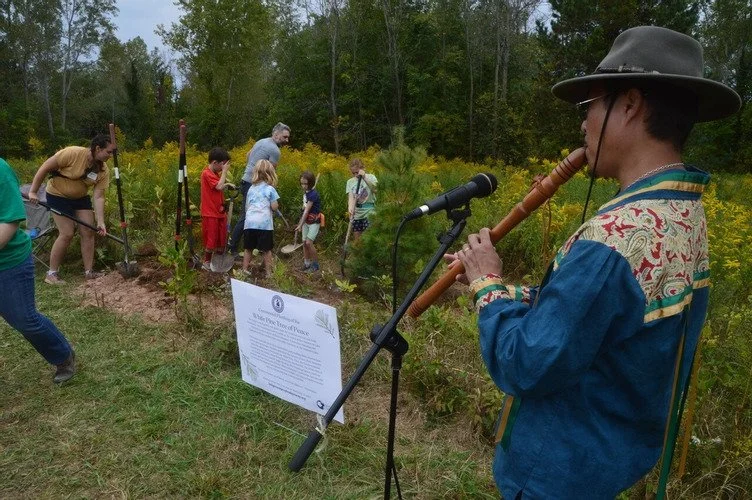
Planting of an Eastern White Pine at Deer Creek Woods in 2024. Photo by Kathryn Elble.
Eastern White Pine Quick Facts
Height: 100-150 ft., with up-to a 4-ft. Diameter.
Age: Average of 200 years in age, with the oldest recorded at 450 years strong. Age can be estimated by counting each whorl of branches on the trunk.
Identification: Bluish-green soft and feathery needles that grow up to 3-5 inches long. Each branch has 5 fascicles (pine needle clusters), like the Five Nations.